
Independent Aerospace R&D / WHT-001

Wild
Hunter

Precision in the Unknown.

01 Autonomous Systems 02 Aerospace Engineering 03 Resilient Navigation 04 Modular Architecture 05 Verification First 06 LAHAV CommandOS / OSINT 01 Autonomous Systems 02 Aerospace Engineering 03 Resilient Navigation 04 Modular Architecture 05 Verification First 06 LAHAV CommandOS / OSINT
01 / MISSION
Built for uncertainty

Engineer the
unknown.

Wild Hunter Technologies is an independent advanced-engineering company exploring autonomous aerospace systems for demanding and uncertain operating environments. We work from first principles: simplify the architecture, validate the assumptions, and design safety into the system from the beginning.

Systems thinking / high-integrity engineering / responsible autonomy

Philosophy & Mission →
IndependentFast iteration without organizational drag.
ModularSubsystems designed to evolve without full-platform redesign.
ResilientArchitecture built around graceful degradation and verification.
MeasuredEngineering claims separated from assumptions and validated evidence.
X1
02 / PLATFORM
Experimental aerospace platform

LAHAV-X1

A research platform for exploring long-endurance autonomy, robust navigation, modular airframe architecture, remote inspection, environmental monitoring, and search-and-rescue mission concepts.

AutonomyLong Endurance Modular AirframeNavigation Resilience Safety Systems
View Technology Areas →
03 / SOFTWARE SPOTLIGHT
Public sources. Connected context. Human judgment.
LAHAV / Software family

LAHAVCommandOS

OSINT Targets
Generation Engine

Research & development / concept preview

This Open-Source Intelligence (OSINT) module serves as a conceptual software engine within the LAHAV CommandOS architecture. Its proposed design ingests unstructured public information and synthesizes it into structured intelligence records, connected evidence, and contextual threat profiles for access-controlled analyst review.

The proposed intelligence pipeline follows a sequential, five-stage journey: initial data ingestion, metadata extraction at the edge, centralized cloud processing, human-in-the-loop analyst review, and an analyst-validated, source-linked evidence brief. The architecture maps the edge and processing roles across the LAHAV family, with LAHAV CommandNode supporting source context and local analysis.

Proposed capabilities / select to explore

Public-Source Exploitation

Systematic ingestion and baseline analysis of publicly available data streams.

Evidence Traceability & Chain-of-Custody

A proposed cryptographic provenance layer would link intelligence outputs to their original source data. Chain of custody additionally requires documented collection, handling, transfers, and integrity checks; implementation and validation remain pending.

Contextual Threat Analysis

Structure raw, multi-source public data into connected analytical context, retaining source confidence, conflicting observations, and uncertainty.

Human-in-the-Loop (HITL) Analyst Review

Keep human judgment as the final validation step before an evidence brief is finalized for authorized research review.

Discuss LAHAV CommandOS
LAHAV CommandOS / Intelligence workflow Five stages. Connected evidence. Human judgment.
01 / Data ingestion Automatic loop · illustrative workflow
01 Data ingestion
Public reportsDocuments / publications
Open imageryPublic visual sources
Public datasetsStructured open data
Sensor metadataRF / optical / context

Source Intake

Capture & organize information

02 LAHAV CommandNode

LAHAV
CommandNode

Metadata extraction
Source references & context

03 Cloud processing

Processing Engine

From source records to an evidence brief
01
Normalize & Validate
02
Fusion & Deduplication
03
Cross-source Correlation
04
Draft Evidence Brief
04 Human review
Decision Support UI

Human
in the Loop

Evidence / context
Uncertainty / limitations

Analyst override

Awaiting research records

05 Research result
Reviewed research result

Evidence
Brief

Research context
Environmental observation
Provenance
Sources + timestamps
Review record
Findings + open questions
Awaiting analyst review
Automatic loop / ingestion to research resultIllustrative evidence flow
Five stages / proposed workflow

LAHAV CommandOS
Workflow Overview

Follow public information through connected analysis, human judgment, and a source-linked evidence brief.

01Data ingestionPublic sources
Workflow stage

Ingest public reports, open imagery, public datasets, and sensor metadata.

Purpose

Capture incoming information while retaining the original source context.

Output

Organized source records ready for metadata extraction and analysis.

02LAHAV CommandNodeMetadata & source context
Workflow stage

Extract source references, timestamps, and contextual fields.

Purpose

Keep each observation connected to its origin and surrounding context.

Output

Context-rich records prepared for the next processing stage.

03Cloud processingFour processing steps
Workflow stage

Normalize & Validate; Fusion & Deduplication; Cross-source Correlation; Draft Evidence Brief.

Purpose

Connect related observations while preserving original references, timestamps, and uncertainty.

Output

A draft Evidence Brief prepared for human review.

04Human reviewAnalyst validation
Workflow stage

An analyst reviews the evidence, context, source quality, and uncertainty.

Purpose

Retain human judgment, including the ability to revise, reject, or request further evidence.

Output

A review record documenting findings, limitations, and open questions. This animation illustrates the review stage; it performs no real approval.

05Research resultReviewed evidence
Workflow stage

Produce a finalized, source-linked Evidence Brief.

Purpose

Present reviewed findings with supporting sources and an explicit account of uncertainty.

Output

A reviewable research result linked to its evidence and review history.

Security engineering / documentation required

Security & Architecture
Gap Analysis

Integration assurance / unverified

The visual concept does not provide sufficient technical data to assess isolated research deployments or demonstrate hardware and firmware isolation during processing. Integration and security assurance remain open engineering questions.

SEC 01 / EXECUTION BOUNDARYUnspecified
Hardware & firmware isolation

Trust boundaries & validation evidence

Document supported hardware and firmware baselines, protected workload boundaries, secure boot and attestation evidence, and administrator privileges.

Evidence still requiredPlatform compatibility · isolation guarantees & limits · firmware trust chain · security test results
SEC 02 / EVIDENCE HANDLINGUnspecified
Evidence integrity & transfer

Authorized interfaces & traceable handling

Specify source provenance, integrity verification, approved evidence-transfer interfaces, access controls, key management, and tamper-evident audit records.

Evidence still requiredCollection & transfer records · authorization model · integrity checks · key custody & recovery procedures

Offline / cloud boundary. State whether each deployment is offline, intermittently connected, or networked. A genuinely air-gapped deployment needs a separately documented, approved transfer workflow; live cloud connectivity cannot be assumed.

Security basis & validation limits

The supplied material establishes a conceptual workflow, rather than a validated deployment or security architecture. A zero-trust design must define identity, authorization, resource protection, and validation criteria. Isolation or network location alone does not establish trust.

Cryptographic provenance and a documented handling history are proposed evidence requirements. They do not by themselves establish the accuracy of a source or verify an intelligence conclusion. No implementation evidence or security test results were supplied for these capabilities.

These references inform the documentation requirements; they do not represent certification or a finding of LAHAV compliance.

Data management / validation requirements

Evidence continuity.

Evaluation pending

Source preservation and research analysis require defined retention, retrieval, and validation criteria. The concept does not establish measured performance for these capabilities.

01 / SOURCE PRESERVATIONEvaluation pending
Preserve the evidence

Retain original source material and context so research findings remain traceable.

Evaluation criteriaCompleteness · retention · retrieval · integrity
02 / RESEARCH ANALYSISEvaluation pending
Support the analysis

Support timely review of connected observations, research records, and findings.

Evaluation criteriaResponsiveness · consistency · review history · uncertainty

Evidence continuity. Source context and review history remain linked to each evidence brief.

Source basis & open decisions

The proposed five-stage workflow is conceptual. Its performance, deployment readiness, and acceptance criteria remain subject to engineering validation.

Open decisions include expected data volumes, retention periods, review requirements, and evaluation criteria.

Public information → reviewed evidence → research resultIllustrative workflow. Animation speed is not measured system latency.
04 / LAHAV COMMANDNODE
Local intelligence / platform concept

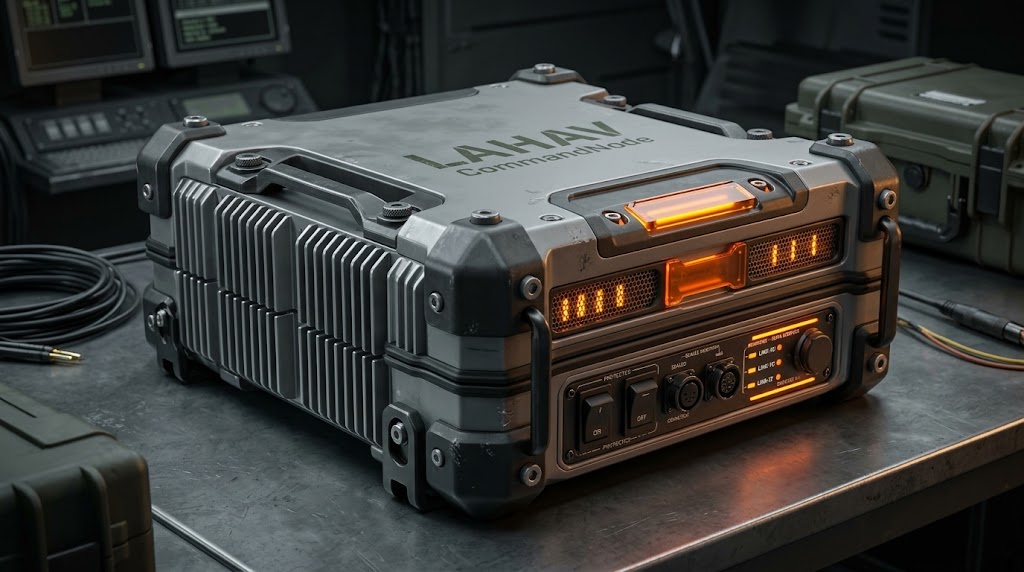
LAHAVCommandNode

Closed-network edge computing, hardware-isolation research, AI-assisted decision support, and resilient coordination.

A proposed local computing platform within the LAHAV family, bringing evidence processing, simulation, and human review closer to the research environment.

Research & development / concept
LAHAV CommandNode concept enclosure in tungsten gray with orange accents
Concept visualization / enclosure and final configuration subject to engineering validation.
01 / LOCAL COMPUTING

Air-Gapped Edge Computing

A proposed local AI research configuration based on NVIDIA DGX Spark and the GB10 Grace Blackwell architecture. Closed-network operation, internet isolation, and approved offline evidence transfer require validation for each deployment.

Hardware reference ↗
02 / SECURITY RESEARCH

Hardware Isolation & Integrity

Evaluate protected analytical workloads, controlled access, and firmware integrity verification. Security assurances depend on supported hardware, firmware, a defined threat model, and independent validation.

03 / HUMAN JUDGMENT

AI-Assisted Decision Logic

A proposed Decision Support UI presents evidence, uncertainty, and resource considerations for analyst assessment. Human review remains the final validation step for research findings.

04 / COORDINATION RESEARCH

Resilient Coordination

Explore distributed coordination for unarmed inspection, monitoring, and search-and-rescue research. Focus on simulation, observability, and predictable fallback behavior before field validation.

Concept overview. No validated field performance, security certification, or compatibility with a particular confidential-computing mechanism is claimed.

Discuss LAHAV CommandNode
05 / TECHNOLOGY
Core engineering domains

Systems,
not features.

01

Autonomy

Mission-state management, onboard decision logic, health monitoring, and predictable fallback behavior.

02

Navigation

Sensor fusion, navigation integrity, degraded-mode operation, and position-confidence management.

03

Airframe

Aerodynamic efficiency, manufacturability, modular packaging, maintainability, and environmental durability.

04

Verification

Simulation, requirement traceability, test planning, failure-mode analysis, and evidence-driven iteration.

06 / PRINCIPLE
“Precision is not the absence of uncertainty. It is the ability to operate responsibly inside it.”
Wild Hunter Technologies / Precision in the Unknown.
07 / NEWS
Company perspectives & research updates

Inside the
process.

Explore the LAHAV concepts and the engineering principles behind our research.

08 / REQUEST DEMO

Request a
Demo.

Discuss your research use case and explore the LAHAV family with Wild Hunter Technologies.